The Tournament Edition
Every game becomes a lesson.
The premium tournament scorebook for players who want to improve. 50 games, a facing analysis page for every game, and a full season review.
Ships from the United States in 3 to 5 business days
- Lies fully flat
- 50 games
- Standard algebraic notation
- Secure checkout

- 120 pages
- A5 Wire-O, lies flat
- 100 GSM cream paper
- Up to 80 moves per game
- Designed with chess coaches
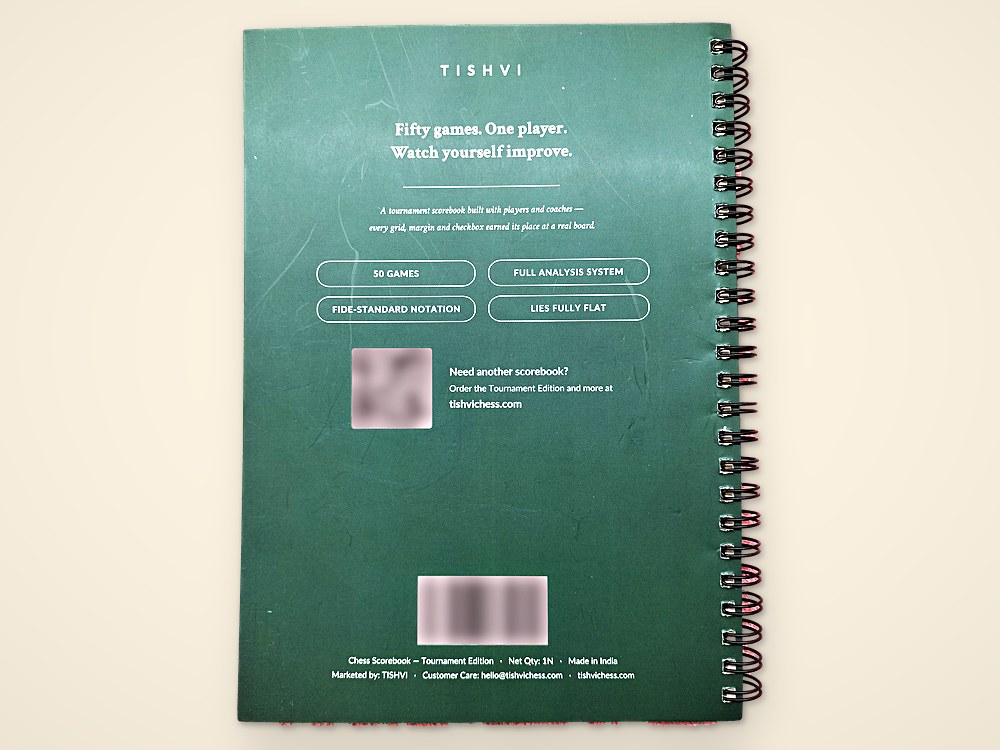
- Made in India
Why Tishvi
A scoresheet keeps the moves. Tishvi keeps the lesson.
Most players never look at a game again once it ends. The scoresheet goes into a drawer, and the same mistakes come back at the next tournament. Tishvi gives every game a page for the lesson, and every season a place to see the pattern.
| Feature | Loose scoresheets | Ordinary scorebook | Tishvi |
|---|---|---|---|
| All games in one place | Not usually | Yes | Yes |
| Room for 80 moves | Not usually | Not usually | Yes |
| Clock tracking | Not usually | Not usually | Yes |
| Facing analysis page | Not usually | Not usually | Yes |
| Critical-position diagrams | Not usually | Not usually | Yes |
| Season-level pattern review | Not usually | Not usually | Yes |
| Tournament prep pages | Not usually | Not usually | Yes |
| Lies flat while writing | Not usually | Not usually | Yes |
What each kind typically offers; individual products vary.
How it works
Record. Analyze. Improve.
-
 01
Record
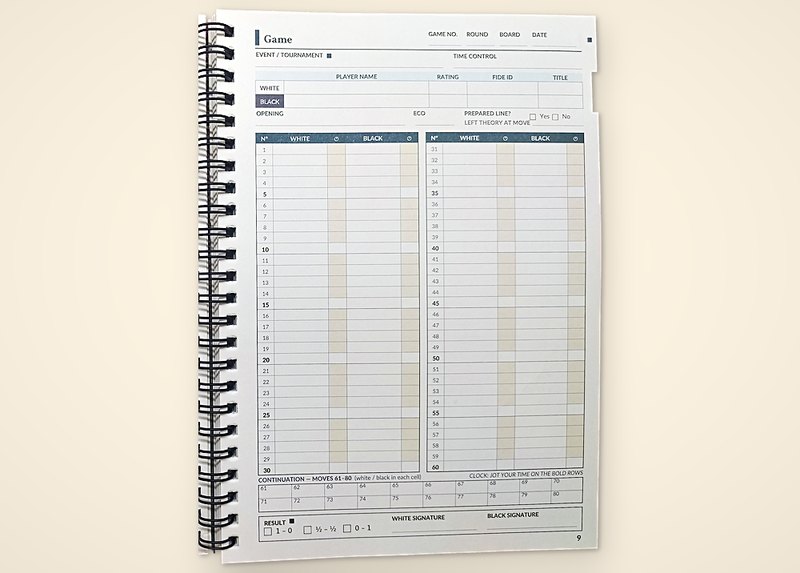
Write the game move by move, with a clock column beside every move and room for 80 moves.
-
 02
Analyze
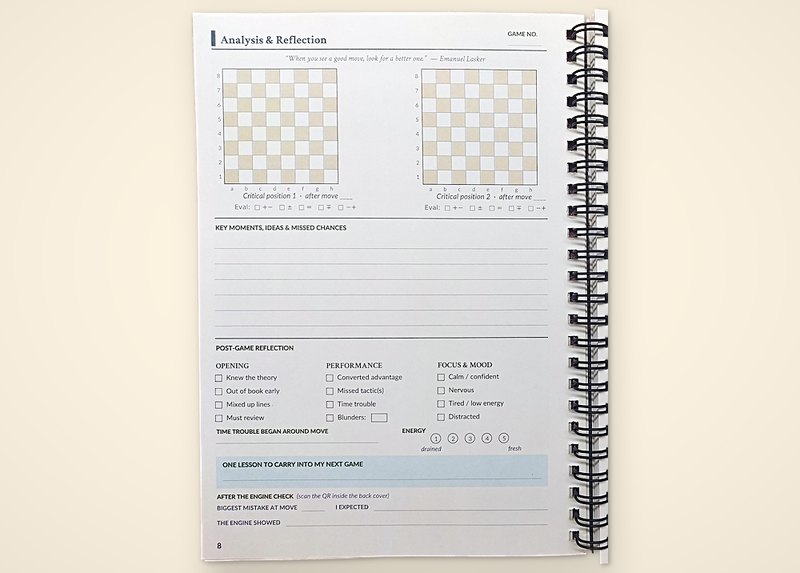
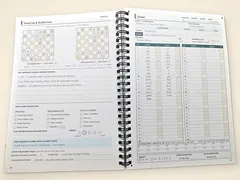
On the facing page, set up two critical positions, tick your reflections and write one lesson for your next game.
-
 03
Improve
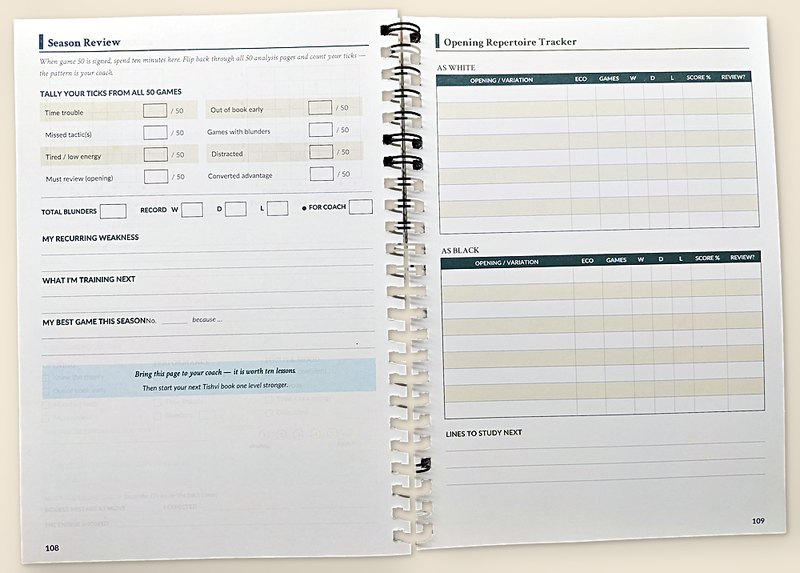
The Season Review tallies your ticks from all 50 analysis pages, so the patterns show.
Inside the book
Every page has a job.
The book follows the rhythm of tournament chess: record the game, examine the decisions, then carry one useful lesson forward.
Notation that stays legible
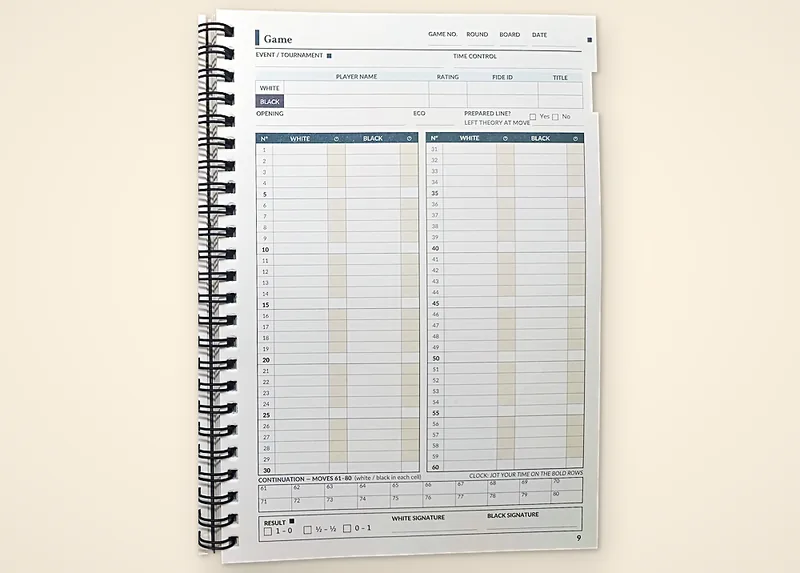
- Moves 1 to 60 in two columns, White and Black side by side.
- A clock column beside every move. Jot your time on the bold rows, every fifth move.
- A continuation strip on the same page takes long endgames to move 80.
- Game number, round, board, date, event, time control, both players with rating, FIDE ID and title, opening and ECO.
- Result boxes and both signatures, as an arbiter expects.
Long games never run off the page.
Select the image to enlarge it.
The lesson faces the game
- Two critical-position diagrams, each with the move number and an evaluation to tick.
- Lines for key moments, ideas and missed chances.
- Post-game reflection ticks for opening, performance, focus and mood, plus when time trouble began and your energy from 1 to 5.
- One lesson to carry into your next game.
- After the engine check: your biggest mistake, what you expected, and what the engine showed.
Name the decision that changed the game.
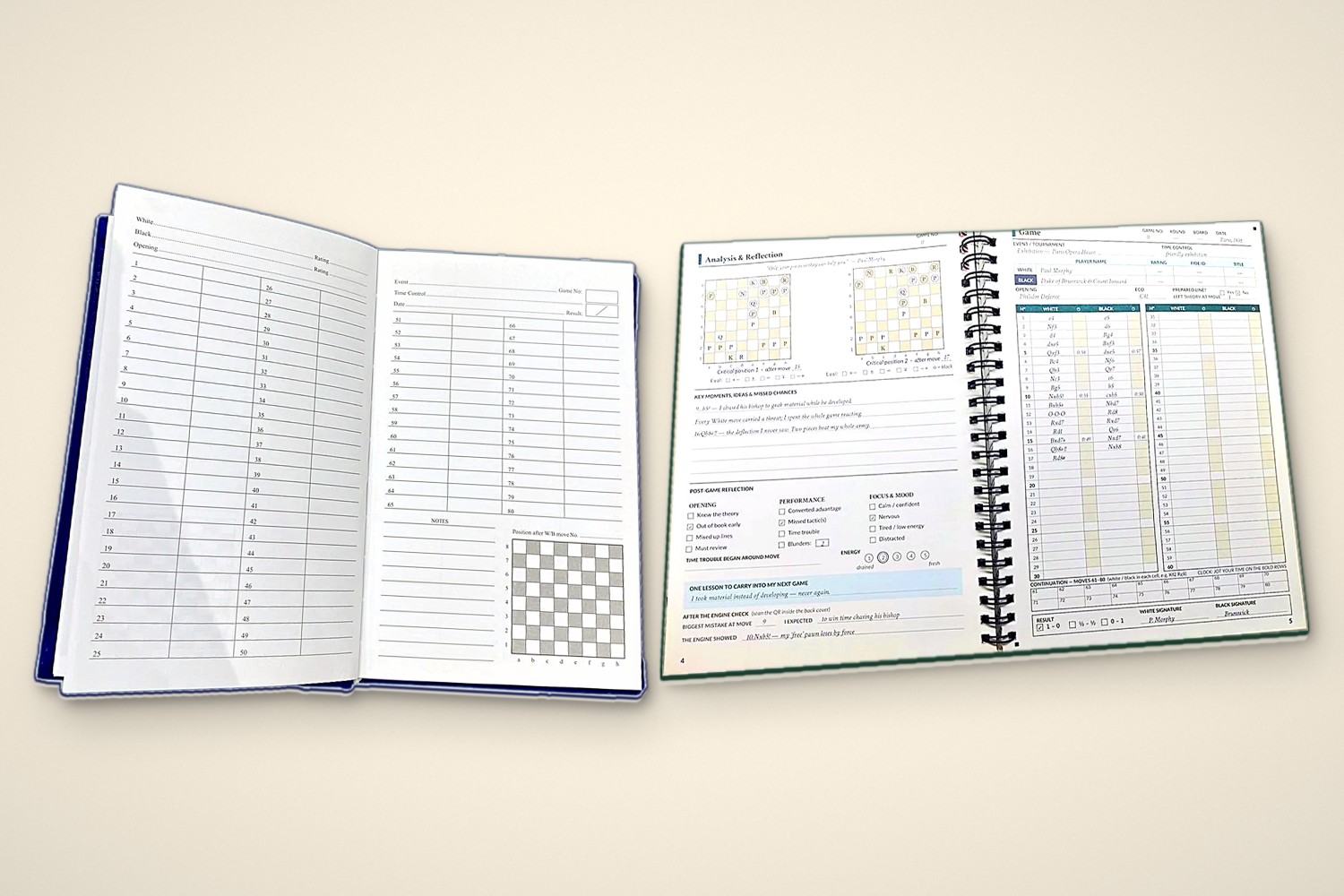
A worked example to start from
Game 0 is Morphy's Opera Game, Paris 1858, filled in on a real Game page, with its Analysis & Reflection page completed from the losing side: the two critical positions, the key moments, the reflection ticks, one lesson and what the engine showed.
See how a score becomes a lesson before you write your own.
Patterns across a whole season
- Flip back through all 50 analysis pages and tally your ticks: time trouble, missed tactics, blunders, low energy, distraction, opening trouble and more.
- Total blunders, your win, draw and loss record, and a box for your coach.
- Your recurring weakness, what you will train next, and your best game of the season.
- Bring this page to your coach.
50 separate games become one clear picture.
Master Game Index
Every game on one spread: date, event and round, opponent, rating, colour, opening and ECO, and result. Star the games worth a deep review with your coach.
Find any game in seconds.
Prepare, reset, return to the board
Event, venue, dates, time control and section, then a round-by-round table: date and time, board, opponent, rating, their openings and your prep notes, colour and result. Space to prep for your next round and to note what to review tonight.
Between rounds: water, food, a short walk, fresh eyes for the next battle.
Opening Repertoire Tracker
Separate tables for your openings as White and as Black: variation, ECO, games played, wins, draws, losses, score % and a review flag. Then the lines to study next.
Know which lines are working for you.
Rating Progress
Log each event with its format, your rating before, your performance and your rating after, then plot your journey on the grid. A short formula on the page estimates your performance rating.
Watch the line move as the lessons add up.
Position Notebook
Blank diagrams, each with the game and move number and room for notes, for the positions worth remembering.
Your own book of positions that taught you something.
Quick Reference
Annotation symbols, the touch-move and phone rules, how to claim a draw under FIDE Article 9, and the scorekeeping rules arbiters expect.
The rules that matter at a rated event, one page away.
The book itself
Made to be used at the board.
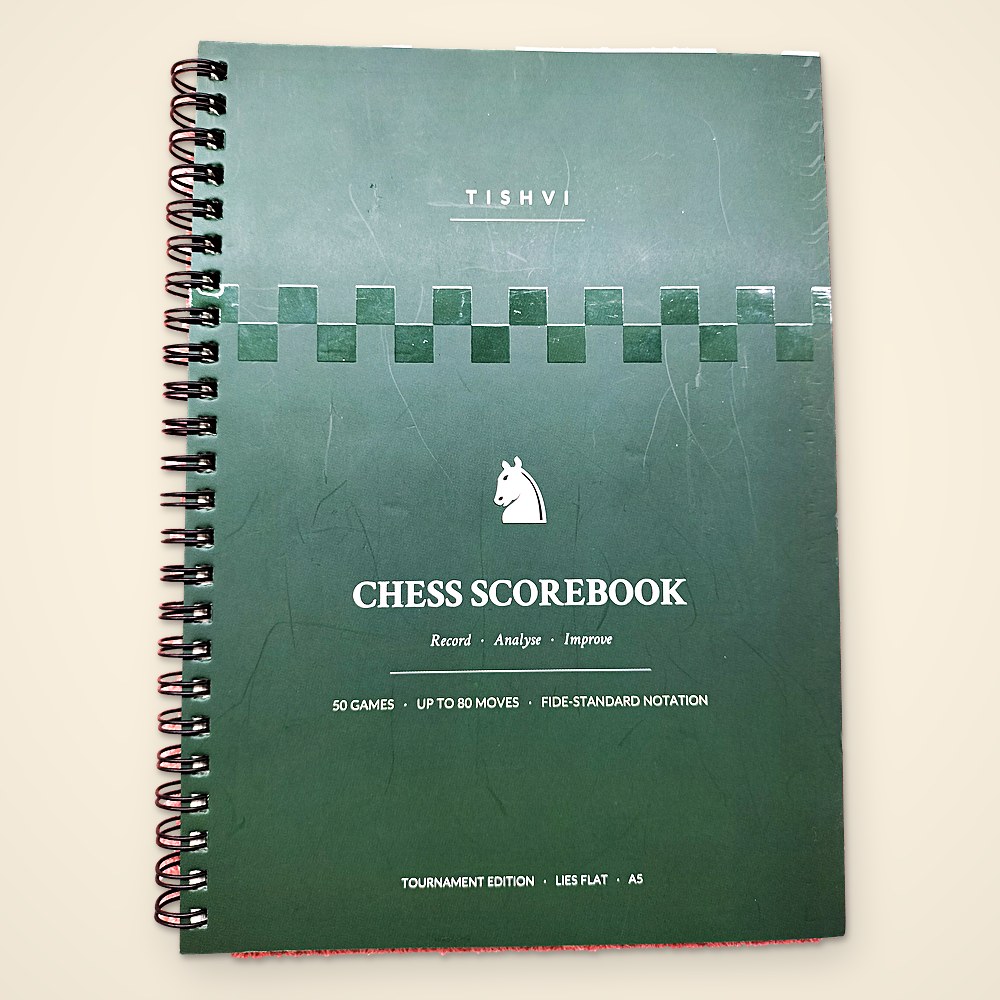
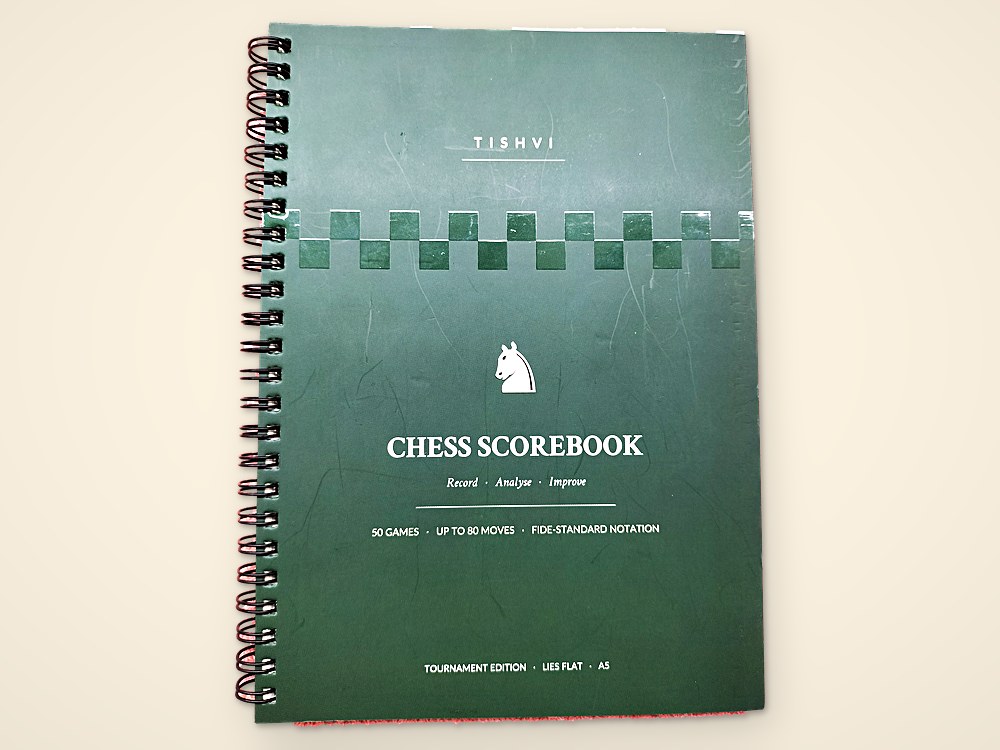
100 GSM cream paper. Heavy enough to write on with a pen, and softer on the eyes than bright white paper across a long tournament day. The cover is 300 GSM matte-laminated, and the matte-black Wire-O binding lets the book lie fully flat.
For players
Write it at the board. Learn from it after.
Clear rows for every move
Room for up to 80 moves a game, with clock times sampled every fifth move.
A facing page for the lesson
Mark the critical positions and name the decision that changed the game.
Something to review with a coach
Fifty games in one book, ready for the post-game conversation.
A thoughtful gift for any chess-playing child or adult.
Two ways to get it
Order it here or on Amazon.
Pick whichever you trust more. Both lead to the same scorebook.
Free companion app
Turn your scorebook games into PGN.
Photograph your notation page, type in your moves while you look at it, and download a PGN file for analysis on Lichess or Chess.com. The app checks every move against the rules of chess, so you can't go wrong.
- Works offline after the first visit.
- Your photos and games stay on your phone.
- Free, with no account to create.


Tournament Edition
Tishvi Chess Scorebook — Tournament Edition
Fifty complete game systems in a lay-flat scorebook, from first move to season review.
Value: about per game
Choose your country to see delivery time.
Ordering for India? The India site is priced in rupees, ships with Shiprocket and offers Cash on Delivery.
Go to the India siteShips from the United States in 3 to 5 business days
- Duties & taxes included
- Tracked delivery
- Secure checkout
- Refund if anything is wrong
Damaged or wrong item? We replace it or refund it.
A gift for a chess player, ready to open.
Specifications
- Size
- A5 (5.8 × 8.3 in)
- Pages
- 120
- Binding
- Wire-O 3:1, lies fully flat
- Interior
- 100 GSM cream paper
- Cover
- 300 GSM matte-laminated
- Games
- 50, up to 80 moves each
Delivery & returns
Ships from the United States in 3 to 5 business days, with tracking. Follow your order any time from Track order.
Returns and refunds are explained on our Shipping & returns page.
For coaches & academies
Give every post-game conversation a place to begin.
- Free sample for coachesFor active coaches with a verified FIDE profile. One per coach, while copies last.
- Academy bulk pricingOrder for a whole batch of students.
- One shared analysis systemEvery student brings the same pages to review, so lessons start faster.
Do I pay customs or import duty?
No. Your order is delivered duty-paid, so there are no customs or import fees to pay on arrival.
How long does international delivery take?
Orders ship from the United States and arrive in 3 to 5 business days, with tracking.
Which countries do you ship to?
Choose your country in the Ship to list. If we do not ship there yet, leave your email and we will tell you when we do. You can also buy on Amazon.com.
How do I track my order?
Open Track order and enter the email you used at checkout. We send you a code, then show your order and its status.
What if it arrives damaged?
Write to with your order number and a photo, and we will replace it or refund it. Details are on our Shipping & returns page.
Is it allowed at US Chess / FIDE events?
It follows standard algebraic notation used at FIDE and US Chess rated events. Always follow the tournament director's or arbiter's instructions and any requirement to use an official scoresheet.
Is this suitable for a beginner?
Yes. A Quick Reference page at the front explains annotation symbols and the key tournament rules, and a filled-in example game shows how every page is used. A beginner can start simply and use more of the system as their analysis develops.
What if I'm left-handed?
The Wire-O binding sits on the left. The book still opens fully flat, so both pages stay stable and usable while you write.
What paper is it printed on?
The pages are 100 GSM cream paper. Heavy enough to write on with a pen, and softer on the eyes than bright white paper across a long tournament day. The cover is 300 GSM and matte-laminated.
How is this different from a normal notebook?
Each game has a purpose-built notation grid and a facing analysis page. The Season Review then helps you tally recurring patterns across all 50 games, something loose notes cannot do consistently.
“Every champion keeps score.”TishviBuy now
From players and coaches
What people say.
out of 5 from ratings on
Used by coaches at
Founding Coaches Programme
We are sending copies to chess coaches.
Coach? Request a free sample and tell us how your students use it.
Request a free sample